The Gut Lining: Your Body’s Gatekeeper”
If you’ve been chalking up fatigue, brain fog, hair loss, or bloating to “just getting older,” you’re not alone — but age may not be the whole story. Increasingly, research points to the health of your gut lining as a major, often-overlooked factor behind these everyday symptoms.
The Gut Lining: Your Body’s Gatekeeper
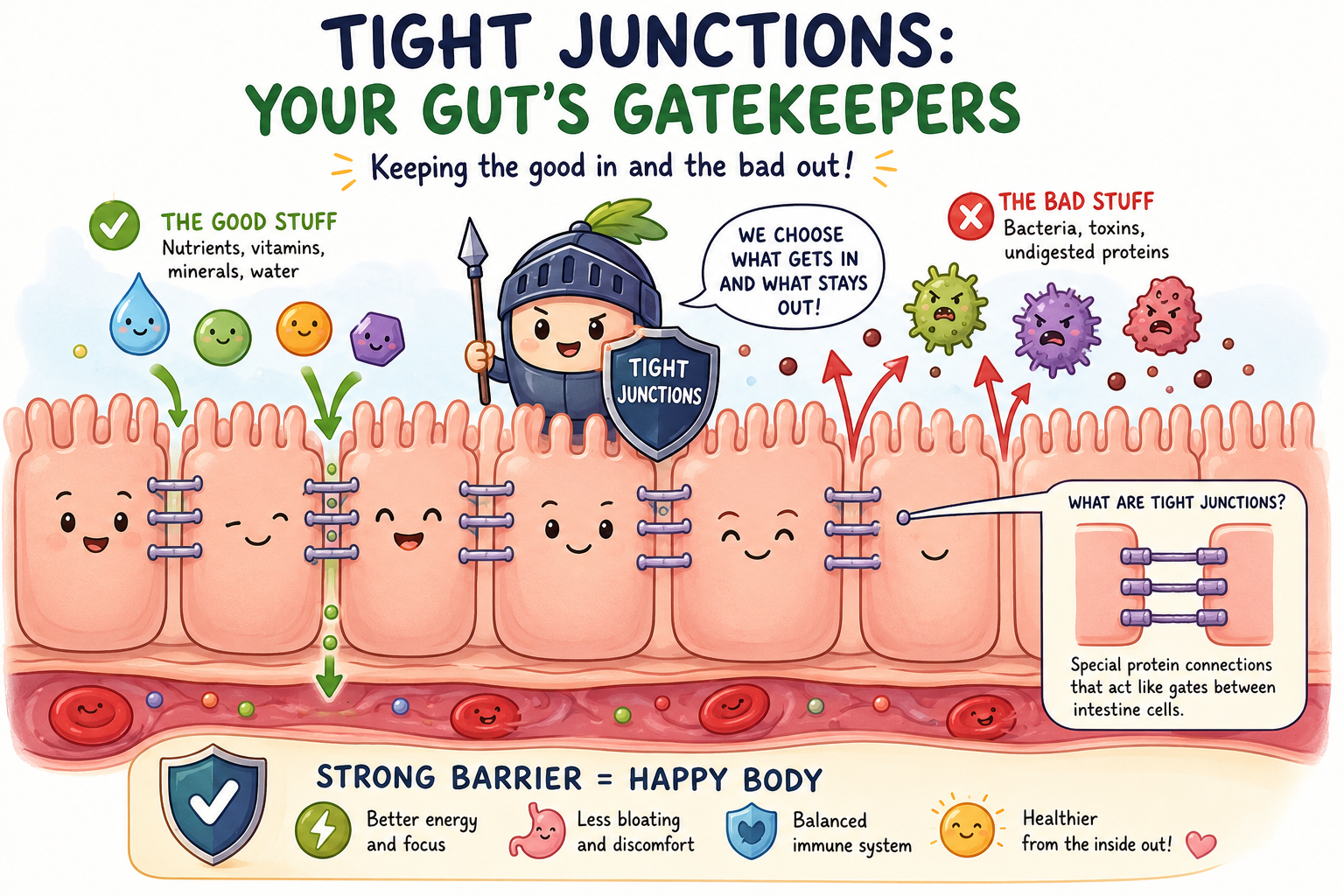
Your intestinal lining is a single layer of cells that decides what gets absorbed into your bloodstream and what stays out. Held together by structures called tight junctions, this barrier is remarkably thin — and remarkably sensitive to stress, age, diet, medications, infections, and environmental toxins.
When that barrier becomes compromised — often referred to as increased intestinal permeability — larger molecules and bacterial byproducts can slip through, triggering low-grade inflammation throughout the body. This disruption of tight junction integrity allows larger proteins to leak into the bloodstream, which can initiate a systemic inflammatory response .
That inflammation doesn’t stay confined to the gut. Once the gut barrier becomes compromised, bacterial byproducts like lipopolysaccharides (LPS) can enter systemic circulation, triggering a cascade of pro-inflammatory cytokines (IL-6, TNF-α, IL-1β) that affect the whole body — not just digestion. This pattern has been linked to a surprising range of conditions across multiple organ systems:
Lungs: Researchers describe a “gut-lung axis,” where gut microbial imbalance and increased permeability can drive inflammation and immune dysregulation in the lungs  — and extraintestinal manifestations of gut inflammation commonly involve the skin, joints, eyes, and lungs .
Reproductive health: There’s growing evidence connecting gut health to conditions like endometriosis. Research increasingly supports the concept that endometriosis is a systemic inflammatory condition involving gut-immune crosstalk, rather than a purely localized pelvic disorder . Gut microbiota imbalances can disrupt immune function, increase inflammation, and contribute to the chronic inflammatory state seen in endometriosis . Similar gut-driven inflammatory patterns have also been studied in relation to recurrent pregnancy loss and PCOS.
Immune system: Perhaps most importantly, a compromised gut barrier places ongoing strain on the immune system. A disrupted gut barrier and microbiome can drive dysregulated systemic inflammation  — essentially keeping your immune system in a state of low-grade, chronic activation.
Mitochondria: The Cellular Power Plants Caught in the Crossfire
There’s one more piece to this puzzle that helps explain why gut-related inflammation so often shows up as fatigue specifically: mitochondria.
Mitochondria generate up to 90% of your cellular energy (ATP) through a process called oxidative phosphorylation  — essentially, they’re the power plants inside nearly every cell in your body, fueling everything from muscle movement to brain function to tissue repair.
When gut inflammation allows inflammatory substances into the bloodstream, that persistent low-grade inflammation places stress on mitochondria and can reduce their ability to produce energy efficiently . The relationship works both ways too — proper mitochondrial energy supplies help maintain the tight junctions between intestinal cells, while mitochondrial dysfunction can compromise that barrier and promote further systemic inflammation , creating a self-reinforcing cycle.
When mitochondria can’t keep up with energy demands, cells shift to less efficient energy production, creating symptoms that mimic multiple chronic conditions  — and poor mitochondrial function often underlies unexplained fatigue, brain fog, muscle weakness, and exercise intolerance .
In other words: it’s not just that gut inflammation makes you feel “off.” It can directly impair the energy-production machinery in every single cell of your body — which is why the fatigue associated with gut issues often feels so deep and pervasive, unlike the tiredness from a poor night’s sleep.
And the impact doesn’t stop there. This same chronic inflammatory pattern has also been linked to brain and cardiovascular health. Gut permeability appears to increase with aging, allowing bacterial components to enter circulation and trigger a peripheral inflammatory response , and alterations in gut microbiota, increased gut permeability, and chronic inflammation are all factors that contribute to cognitive decline and the neurodegenerative processes seen in Alzheimer’s disease . Similarly, gut dysbiosis and disrupted intestinal integrity have been linked to stroke and cardiovascular disease .
The throughline across all of these conditions is the same: a compromised gut barrier doesn’t just cause local symptoms — it can become a quiet driver of inflammation throughout the body, contributing to symptoms (and conditions) that are often attributed to “just getting older.”
It’s Not Just Age — It’s Accumulated Stress
The gut lining is constantly being worn down and rebuilt. Chronic stress, poor sleep, processed foods, alcohol, certain medications, and infections all place ongoing demand on this repair process. Over time, if the stressors outpace the repair, the lining becomes thinner and more permeable.
The encouraging part: this is often identifiable and, in many cases, improvable — by identifying what’s driving the damage and giving the gut what it needs to repair itself.
L-Glutamine: A Key Building Block for Gut Repair
One of the most well-studied nutrients for supporting gut lining repair is L-glutamine, an amino acid that serves as the primary fuel source for the cells lining your intestines (enterocytes). Enterocytes use roughly 70% of all glutamine absorbed in the body .
Research has shown that cells deprived of glutamine have reduced expression of the proteins needed for tight junction formation, along with increased permeability — but this can be reversed by restoring adequate glutamine levels . Clinical studies have found that glutamine supplementation can improve symptom severity, stool patterns, and intestinal permeability  in certain gut-related conditions.
A Note on Quality
Because dietary supplements aren’t regulated the way medications are, quality and purity can vary widely between brands. In my experience, Pure Encapsulations L-Glutamine has been a reliable, well-tolerated option for patients working on gut repair.
The Bottom Line
Fatigue, brain fog, hair loss, and bloating aren’t things you simply have to live with as you get older. By identifying the stressors affecting your gut lining — and supporting repair with targeted nutrients like L-glutamine — many people see meaningful improvement in symptoms they’d written off for years.
Curious whether gut health might be contributing to your symptoms? Schedule a consultation and we can look into it together.
References
• The role of glutamine in supporting gut health and neuropsychiatric factors, ScienceDirect — https://www.sciencedirect.com/science/article/pii/S2213453021000112
• Gut Microbiota and Endometriosis: Exploring the Relationship and Therapeutic Implications, PMC — https://www.ncbi.nlm.nih.gov/pmc/articles/PMC10747908/
• Gut inflammation associated with age and Alzheimer’s disease pathology, Scientific Reports — https://pmc.ncbi.nlm.nih.gov/articles/PMC10646035/
• Gut permeability and cognitive decline: A pilot investigation in the Northern Manhattan Study, PMC — https://pmc.ncbi.nlm.nih.gov/articles/PMC8186438/
• The Hidden Link Between Gut Health, Mitochondria and Energy — https://taymount.com/the-hidden-link-between-gut-health-mitochondria-and-energy/
• Understanding ATP: Why Your Doctor Focuses on Mitochondria — https://ubiehealth.com/doctors-note/colon-cleansing-fatigue-relief-atp-mitochondria-752q2
Ready to paste into Squarespace. Let me know if you want any sections trimmed or reordered.